The purpose of the lab that was performed was to verify that aseptic technique was being used as well as to test the effectiveness of a cleaning solution of choice. The cleaning solution that I chose was “Professional Lysol – Brand lll Disinfectant Spray – Crisp Linen Scent”. The surface that I decided to test and swab, was the touch pad of my laptop. I chose this surface to test because it is something that is used daily and I believed that the test would reveal that there are more microbes present than I anticipated. I began this lab December 8, around 8pm, and concluded my analysis at 8pm on December 13.
For the purpose of the lab, I was supplied with: Sterile cotton swabs, three petri dishes (culture plates) with nutrient agar, disposable gloves, an ultra fine point Sharpie to label, and Parafilm strips to seal. The three petri dishes served the purpose of verifying different things. One was a negative control, used to verify that aseptic/sterile technique was being performed. Aseptic technique is used to prevent the exposure and production of unwanted microbes inside of the agar culture plates. The second was a positive control to verify swab technique, making sure that microbes were present on the surface before the cleaning solution was applied to it. Lastly, the third dish was the experimental plate, checking to see how effective the Lysol was on disinfecting or cleaning the touch pad from microbes.
Thorough and precautious swabs for each culture were taken, as the negative control was simply the lid of the plate being lifted (not removed or uncovered to prevent exposure) and a removal of a sterilized cotton swab and appliance to the agar culture by dragging the sterile end across the nutrient agar in a zigzag pattern, then rotating the dish 90 degrees and repeating the same swab. The zigzag pattern was as portrayed below:
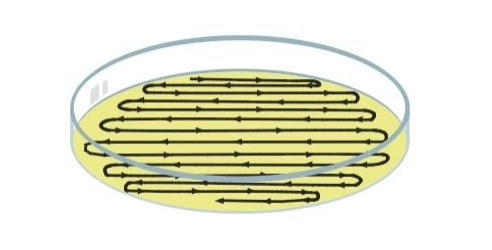
This process was repeated for the positive control swab except that this swab was a wet swab (water taken from the condensation on the lid of the plate) applied to the touch pad of my laptop and then transferred, by swabbing again on the agar plate to ensure that microbes present were collected. The same swab technique was also used for the experimental plate, except that before swabbing, the dry touch pad surface was sprayed using Lysol disinfectant spray and dried with a paper towel. After changing into a new pair of gloves, I proceeded to collect any microbes from my recently disinfected touch pad, and using the swab technique, I transferred the microbes to the experimental petri dish. All three plates were sealed using Parafilm to reduce airflow in order to prevent the microbes from performing aerobic respiration.
The next step was to incubate the cultures. An ideal space for incubation in a lab, would be inside of an incubator set for 37 degrees Celsius (98.6 degrees Fahrenheit), in a dark area. The incubation environment that I chose was on the counter next to the back of my fridge, under a black towel. The reason I chose this incubation environment was because it was the most consistent place (temperature wise) that provided heat and warmth, and the towel prevented direct light from hitting it which otherwise, would inhibit the growth of some microbes.
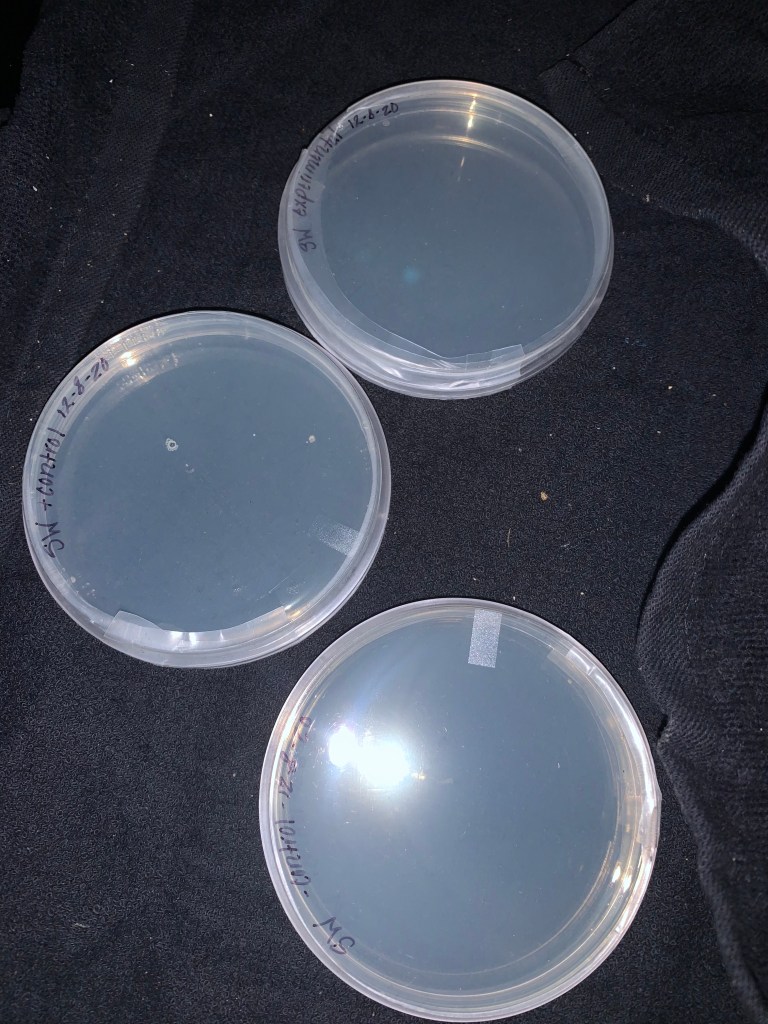
Referring to my lab notebook, the temperature in my house was typically 68-70 degrees Fahrenheit, recorded from my thermostat as I checked around 8pm every night over the course of 6 days, with a total incubation time of about 120 hours. From what was documented, and from analyzing the growth of the negative, positive, as well as experimental culture plates, microbe growth was not present. The appearance of any growth could not be seen. The results did not match my expected outcome as I predicted that the negative plate would have the least amount of microbes present, the positive would have the most, and the experimental would have a fewer amount. I would report my experiment and lab as failed, due to the lack of microbe growth, making results difficult to analyze and rely on since more microbes were supposed to appear in the positive control and did not. I believe that the reason my experiment failed, was because of the temperature of my incubation environment. Although the plates were placed near the back of the fridge for warmth, the temperature of my home in general remained to be a lower temperature, possibly preventing more accurate results. The final image of my experiment is below:
 SaNaya's Poetry Blog