Final Six Weeks Reflection

Dear Ms. Langley,

This year has definitely been quite the experience. It feels as if the year lasted forever, and I am still trying to wrap my head around the fact that it is coming to a close. Although there were many challenges and difficulties throughout this year, I am so glad that you were here to support and guide me through it. As I reflect over this year, I think about the fact that I truly and honestly did learn so much from this year. 

To begin, at the beginning of the year, I came into APlang with the confidence that I was already a great writer with a minimum amount of things left to learn. I quickly discovered that this mindset was completely incorrect. Throughout the year, I learned and discovered new things about myself that I did not know before. For example, I learned that although I am not too fond of timed writing, I am able to complete an entire essay within a limited amount of given time. I also learned that my knowledge has increased significantly as I have now developed an understanding of how to approach various types of essays and provide explicit details to support my thesis and claims on the topic of discussion. Tackling assertions, essays, rhetorical analysis, argument, and synthesis essays have allowed me to become accustomed to approaching prompts with confidence as we have done so much practice and preparation over the course of this school year. 

Next, on the subject of reading, I believe that I have improved in comparison to last year and maybe even last semester. Although I have seen improvement within myself, this is the same area in which I also have much room for more development. I really enjoyed that a lot of the reading that we did was books of our choice, but I also really enjoyed reading the books that were selected for us. I loved reading Citizen and The Bluest Eye by Toni Morrison, I loved reading books that I could relate to and that reflected my racial background. With the assertions that we did, I also enjoyed reading those as well. I loved reading and evaluating the mentor texts, gaining a new perspective on various types of writings, and just being able to analyze and deeply interpret the texts. 

Lastly, writing reflections on a regular basis has caused me to see my improvement and development throughout the school year. I have realized that from my very first letter to this letter, although I may reference the same concepts, my character has changed significantly. The reflections have allowed me to see that, as a person, my strongest area is writing, while my area for improvement is reading. I learned about myself, that I am not perfect, as no individual is. I learned that I have so much more to improve on, but I also realized that I will continue to improve each day as long as I am putting forth the effort to learn and experience new things, while also asking for help when I need it.

In conclusion, the grade that I would give myself is a 98. I feel that over this year, despite all the challenges and uncertainty, I have worked hard to push myself to get through the year and do my best to stay on top of my work. Although there are still many areas for improvement, I am proud of myself and know that I did the best that I could. I am so thankful for this year and for having the opportunity to be taught by you for another year. Thank you so much for everything and I hope that you and your family are doing well. Congratulations on your new grandson!!!

Thank you so much, 

SaNaya White

Keystone XL Pipeline Synthesis Essay

A reoccurring and controversial issue known as the Keystone XL Pipeline has reemerged and is continuing to cause disputes and problems. The Keystone XL Pipeline is an extension to the Keystone Pipeline system, proposed by TC Energy (formerly the TransCanadaCorp) in 2005, which would transport oil from Alberta, Canada, to refineries of the United States. The Keystone XL Pipeline has been controversial for many years as a result of concerns about its effect on global and environmental concepts, negatively impacting the world we live in today and that of the future. President Joe Biden has revoked its order to be built in efforts to uphold his plan to address climate change, and although the order to end the Keystone XL Pipeline will lead to the loss of jobs and economic decrease, canceling the pipeline will provide environmental protection, and eliminate its contribution to climate change.

To begin, there are key concerns when it comes to the Keystone XL Pipeline that would negatively impact society as a whole if it was built, particularly, concern over environmental protection. Source 4 discusses some reasons why the Keystone XL Pipeline must be evaluated carefully, stating, “Environmentalists oppose the project because it would create …an unconventional energy source requiring far more fuel, water and carbon emissions to extract than conventional oil and gas…In one method (producers use to get sands out of the ground), large amounts of water and natural gas are used to pump steam into the sands to extract the oil, which creates toxic environmental runoff”. The article later states that a method of extraction has already destroyed multiple acres of Alberta forest. Source 4 supports President Biden’s call to revoke the XL Pipeline order as it provides specific examples of how the pipeline would impact the environment in detrimental ways and require more resources than we necessarily just have at dispense. 

In addition, as someone in leadership, President Biden implemented an executive order that provides his ideals and future presidential actions that he hopes to attain, specifically those surrounding the discussion of climate change. Source 3 demonstrates President Biden’s viewpoint as it states that “It is, therefore, the policy of my Administration…to reduce greenhouse gas emissions; to bolster resilience to the impacts of climate change”. Under a section solely addressing the revocation of the Keystone Pipeline, President Biden expresses, “The analysis further concluded that approval of the proposed pipeline would undermine U.S. climate leadership by undercutting the credibility and influence of the United States in urging other countries to take ambitious climate action.” Source 3 declares that President Biden and his administration prioritize the United States following a sustainable climate pathway and perceive the Keystone XL Pipeline as something that contradicts these efforts and climate imperatives. 

Despite these reasons on why the Keystone XL Pipeline demonstrates inadequate consequences on society and our environment, abandoning the order does lead to a harmful impact economically. (From the Right) of Source 1, it is portrayed that the government of Canada continues to support the Keystone XL Pipeline, and a supporter, Alberta Premier Jason Kenney, publicly stated “Doing so would kill jobs on both sides of the border, weaken the critically important Canada-U.S. relationship, and undermine U.S. national security by making the United States more dependent on OPEC oil imports in the future”. The article expresses that supporters believe that the cancellation of the pipeline would result in stopping an $8 billion process that has already begun in Canada, it would take away job opportunities for those involved in the project, and it would lead to weakening the relationship between the United States and Canada. According to the supporters, revoking the Keystone XL Pipeline would decrease job opportunities and impact both sides of the border economically.

In conclusion, President Biden chose the best decision for the benefit of the United States. Using logic and reason to decide on how to obtain a sustainable world, led to President Biden’s choice which stands alongside his goals and priorities stated in his executive order. Although the cancellation of the Keystone XL Pipeline could result in a decrease in job opportunities specifically related to the project as well as some economic backlash, this does not outweigh the detrimental effects that the pipeline could place on our climate and environment.

Toni Morrison Argument: What makes a book great, the story or the writing?

Toni Morrison, a Nobel Prize and Pulitzer Prize-winning novelist, essayist, book editor, and college professor had an outstanding and unique perception of what a story means. Toni Morrison’s many stories allow the reader to understand with a deep level of emotion and interpretation. When reading Toni Morrison’s books, they are perfect examples of what makes a book great. Specifically, Toni Morrison’s The Bluest Eye, elaborates on the fact that the writing makes a story great, as opposed to the story itself. Although the story does play a role in the creation and emotional connection between characters and the reader, the writing is what truly makes a book great as it provides the reader imagery, and allegories to provide expression and great detail. 

To begin, Toni Morrison’s detailed and thorough writing style provides the reader with sensory imagery, allowing the reader to have a better understanding and visually connect to the story on a more personal and relatable level. Toni Morrison writes, “Later we walk home, glancing back to see the great carloads of slag being dumped, red hot and smoking, into the ravine that skirts the steel mill. The dying fire lights the sky with a dull orange glow. Frieda and I lag behind, staring at the patch of color surrounded by black” (10). This quote comes from one of the narrators, Claudia, opening up the chapter describing an event involving her sister, Frieda. The sisters were walking back home from railroad tracks near a coal company, where they bagged pieces of coal that they found. The extensive detail and description used within the quote, allows the reader to visually imagine as they are reading, it allows them to have the opportunity to place themself within the story. Rather than Toni Morrison simply stating that the sisters walked home after picking up coal, she takes the reader with the characters through their journey, providing the necessary imagery to give the story extra emphasis, and allow the audience to visually be present at the moment. This use of imagery continues to persist throughout the novel. Toni Morrison writes, “The cat rubbed up against her knee. He was black all over, deep silky black, and his eyes, pointing down toward his nose, were bluish-green. The light made them shine like blue ice” (90). This quote portrays that the use of imagery makes a positive impact on the book. As Toni Morrison describes the cat, with descriptive words such as “deep silky black”, and “shine like blue ice”, her description of its appearance provides the reader with a way to visually imagine and understand what the character is experiencing. The use of imagery plays a role in the overall writing of the story, which plays a large impact on making a book great, as opposed to stating an event with simple terms.

In addition, Toni Morrison’s creation and use of allegories make the story great as it challenges the mind of the reader to find greater meaning in the more concrete details of the story. Toni Morrison states, “It had occurred to Pecola some time ago that if her eyes, those eyes that held the pictures, and knew the sights—if those eyes of hers were different, that is to say, beautiful, she herself would be different” (46). This quote reflects the idea of how Pecola views herself. After witnessing a heavy dispute between her parents, she states that she wished to disappear, but the only thing that remained when she tried, was her eyes. The quote tells us that Toni Morrison uses Pecola’s desire for new eyes, specifically blue ones, as an allegory. Although it seems that Pecola is longing for blue eyes themselves, through Toni Morrison’s writing, we come to conclude that the blue eyes represent more than just eyes, but rather the things that are witnessed through these eyes, and the ideal thought of beauty itself. To support the use of allegories, Toni Morrison writes, “I thought of the baby that everybody wanted dead, and saw it very clearly. It was in a dark, wet place, its head covered with great O’s of wool, the black face holding, like nickels, two clean black eyes…no synthetic yellow bangs suspended over marble-blue eyes, no pinched nose and bowline mouth. More strongly than my fondness for Pecola, I felt a need for someone to want the black baby to live—just to counteract the universal love of baby dolls, Shirley Temples, and Maureen Peals” (190). This statement opposes the ideals of Pecola, but the narrator, Claudia, refers to the blue eyes as something that she wishes that baby does not obtain. Claudia associates blue eyes to the description of her ideal caucasian woman, one with yellow hair, blue eyes, a pinched nose, and resembles Shirley Temple. These characteristics are resented by Claudia, yet they are desired by Pecola, as she believes that blue eyes will allow her to obtain this beauty that caucasian women carry, rather than keep her black skin and associate it with beauty. Toni Morrison’s use of allegories allows the reader to think deeply about the novel and uncover its hidden messages through unique and expressive writing. The lack of challenging the reader’s mind would cause the book to lack being a great story.

Despite imagery and allegories coming from the author’s writing, making the book great, the story itself does play a role in creating an emotional connection between characters and the reader. The Bluest Eye tells a unique story of an African American girl, Pecola, growing up after the Great Depression, who is often regarded as “ugly”. The presence of racism toward her dark skin, and complex issues at home, cause Pecola to become persistent on the desire to obtain blue eyes that she equates to whiteness. It is expressed, “All of our waste which we dumped on her and which she absorbed. And all of our beauty, which was hers first and which she gave to us. All of us–all who knew her– felt so wholesome after we cleaned ourselves on her. We were so beautiful when we stood aside her ugliness” (205). The story itself plays a role in causing the reader to feel for the main characters. Over time, as the story takes the reader on a journey alongside the characters, we learn to understand and have personal connections and relations to them. The quote shares that as we have learned about each of the characters throughout the story, we have grown to have sympathy toward Pecola and the many things that she had witnessed and experienced. 

In conclusion, Toni Morrison’s The Bluest Eye, takes each reader on a journey of interpretation, challenge, emotion, and new experience. After reading the novel, a question that must be answered is whether the story itself is what makes a book great, or if it is the writing. Although the story allows us to connect and begin to understand each character as they are introduced, this is only the beginning of what makes a story great. What truly makes The Bluest Eye great, is its writing, with the use of imagery and allegories to build off of the story and truly make it something meaningful and expressive.

Fifth Six Weeks Reflection Letter

Dear Ms. Langley,

For personal reasons, these past six weeks have been the most challenging for me physically and mentally. Despite this, I did what I could this six weeks and had both some successes, as well as some things that I need to improve on in the future. Throughout these past six weeks, I have learned multiple things about myself that I was not able to see before, and I am glad that I now have the time to reflect on it.

    To begin, a learning goal that I believe I did well on is by being a positive community member, student, and peer.  When it came to being in a breakout room and discussing our book, I would put forth my best effort to be sure that I was contributing and participating, while also making sure that I did not dominate the conversation. I encouraged my peers that did not often contribute to do their best to share and express themselves in any way that they felt was comfortable. In whole group conversations, I alternated with my group members in discussing who would summarize and share what we discussed in our breakout room. On the subject of breakout rooms, I believe that the second learning goal that I had and achieved was asking complex questions and persisting to research them. I would constantly come prepared with questions for my group, and if these questions were not answered, I would do my best to research them on my own and discover answers as well as provide them when we all returned.

    In addition to the previous learning goals, my third would be seeking out mentor text to grow as a better student. Throughout the six weeks, I referred back to numerous books, readings, poems, and the overall writings of others to get a better understanding of how I could improve as a writer. When writing my essay, I wanted to get a good understanding of the kind of person I was writing about, to discover what may have inspired them and encouraged them to produce the idea that was constructed into a beautiful piece of writing before writing my essay. These three goals have helped me prepare for the AP exam as I was able to truly focus on communication and participation, being a curious student willing to research and ask for help to better my understanding, and use mentor texts to discover ways to better myself as a writer.

    Despite the positive learning goals, there are areas in which I need to improve in, such as maintaining my writers notebook. I want to be able to use my notebook outside of class to capture ideas, samples of writing, quotes, and any inspiration that comes up. As I mentioned in the beginning, these six weeks were challenging for me, and I think that in the area of having successful student habits, I need to improve here as well. Specifically, when it came to deadlines, such a the Toni Morrison essay, I was finding it hard to meet them. I was letting outside of school issues over-influence me rather than prioritizing my classes and work first. Next six weeks, I do not want to make the same mistake again.

    In conclusion, I want to thank you for providing me the opportunity to be my best and get better every day. Thank you for reading, and my apologies for the late work this six weeks. I will definitely do my best to make the next six weeks better.

Thank you again!

SaNaya White

Fourth Six Weeks Reflection Letter

Dear Ms. Langley,

I believe that these past six weeks have been unexpected, unpredictable, and a challenge for all students as well as teachers. Despite the obstacles placed in our path, we continued to proceed and accomplish many things. These six weeks, similar to many of the past, I have things that I am proud of, but also some that I know I need to continue to work on and improve which is why I believe that my grade should be between a 90 and a 95.

    In the area of reading, this is where I know I struggle the most. I struggle with reaching the reading goal, quantity-wise, as I read one book this six weeks. The book that I read was Tyrell by Coe Booth. This book allowed me to truly view life from a different perspective. It allowed me to become more aware and grateful for the things that I have been blessed with in my life. I was successful in the area of being able to deeply analyze and reflect on the book that I read. I enjoyed the book, and once I came to find enough time to actually sit down and read, that is what I did. Finding the time to read was definitely the most difficult part for me. My next step is to complete my Toni Morrison book, which I have been enjoying and have been progressing really quickly on.

    On the topic of writing, I truly believe that I have grown as a writer. Writing and being able to express myself is something that I enjoy. Some of the writings that I produced last six weeks includes the Classics assertion, the Toni Morrison rhetorical analysis essay, as well as the Letter from a Birmingham Jail rhetorical analysis essay. I believe I did well in constructing my ideas and using precise analysis when reading the texts to be able to easily understand and formulate my ideas. A challenge of mine was remembering to format my letters, and finding the best way to do it. Looking back at the learning goals and behaviors sheet, I believe that I am portraying growth as am now using mentor texts to shape my own thinking and writing. My learning reflets that my original thinking on complex ideas on readings was very limited compared to how much growth I have achieved now. Developing my habits as a student have been going well. I have become more responsible with turning assignments in on time and completing assigned work. I have done more relationship building with the groups that we have been placed in, whenever in a breakout room I do my best to provide and encourage everyone to participate, and I also create a bond between each of us in case we all need help or need support. 

    Lastly, my goals for these next six weeks are to BECOME A BETTER READER. I want to be a reader who is determined to meet and exceed the reading goal. I definitely want to meet the goal by better using my weekends and working on procrastinating less. I want to continue to develop my writing by asking questions on how I can revise/improve them for next time. Once again, thank you Ms. Langley for continuing to push us to be the best readers, writers, and students that we can be. Something I have noticed is that working remotely has caused me to become better at looking over and reflecting on my own work. In person it is easy to just finish something and ask for feedback, but virtually, it causes me to have to reflect, ask myself if I can improve in any way, and figure out how to make my work better. 

Thank you for reading this,

SaNaya White

“Why Read the Classics?” Assertion

The volume, Why Read the Classics?, by Italo Calvino addresses numerous amounts of definitions for the word “Classics”, as well as provides reasons on why they are important and worth the time of reading. Although Calvino proclaims many statements, the one that is most agreeable is about rereading the most important books from our youth. For example, Mr. Calvino writes, “Even if the books have remained the same (though they do change, in the light of an altered historical perspective), we have most certainly changed, and our encounter will be an entirely new thing.” Mr. Cavino uses this quote to express that although books begin to age as time goes by, they frequently tend to remain the same, unless referring to books discussing historical facts and information. In opposition to this, our perspective profoundly changes, as our character, and we as individuals change and develop, providing a new encounter and interpretation after rereading a book. In Mr. Calvino’s third definition of a Classic, he states that, “The classics are books that exert a peculiar influence, both when they refuse to be eradicated from the mind and when they conceal themselves in the folds of memory, camouflaging themselves as the collective or individual unconscious.” Within this definition, Mr. Calvino is referring to the idea that the Classics are books that provide a specific type of influence, one that remains in the mind of an individual, no longer becoming a reading, but rather a memory, intertwining with the unconscious mind of an individual. This supports the importance of rereading a book from youth, as rereading allows one to collect additional information and expressions, becoming a part of memory. The more a Classic is read, the more knowledge will be received unconsciously, as well as used. To conclude, Mr. Calvino’s statement from Why Read the Classics?, includes a statement that describes the importance of revisiting and rereading a book from our youth. This statement is important as it is something that must be considered by all individuals, especially those that are more mature and have read specific Classics during their youth that must be revisited to obtain additional and beneficial knowledge.

About Me

I live by a quote that my grandma once told me in middle school, “Nothing is impossible, it is just a challenge that you must overcome.” Having this quote in my mind, has allowed me to push myself to become the best person that I can be. I focus on recognizing these challenges and using them to motivate myself into transforming challenging tasks into personal accomplishments and achievements.

One academic accomplishments that I am most proud of is being awarded the African American Heritage Award four times. I am proud to have the opportunity to show individuals that being an African American should never be portrayed as a barrier, or a reason not to do the best that we can be. I want to be a leader for those in my community, and provide a positive perspective to other African Americans who have been degraded by society and need the inspiration to show them that it is possible to rise above it all. Besides the African American Heritage Award, my second academic accomplishment that I am proud of is being nominated to be titled a “Groundbreaking Woman” by my peers. I think it is incredible that my peers saw me as an individual that holds the characteristics of being a young woman that is a “originator, innovator, risk-taker, and pioneers in a particular discipline. Strives to improve her community, leads with courage and compassion, and despite adversity, reaches high levels of success in her chosen career path.”

When focusing on personal accomplishments, one that I am proud of is being able to be involved in band, basketball, track, kickball, and other out of school organizations, all while maintaining straight A’s. I think it is important to stay busy while being capable of balancing and handling the personal activities that I enjoy as well as making time for school. My second personal accomplishment that I am proud of is continuing to be an active writer (Youth Brigader) for Austin’s local Villager Newspaper. I have been writing since I was six years old, and I am proud of myself for being able to write about things within my community as well as in society as a whole, bettering myself and informing others who read my articles.

I believe that my greatest academic strength is perseverance. Just as discussed in the beginning, no matter how difficult an assignment/activity is, I push myself to strive for excellence and success. An example of this is that I often find being involved in sports and dealing with numerous hours of homework a night difficult and tiring. I will wake up super early for practices, even though I went to sleep late from studying, and preparing the night before. Although difficult, I persevere and over time, learn to adjust my schedule to help better myself physically and mentally. In opposition to this, I believe that my greatest weakness is time management. I have always struggled with setting out time frames to work and to prevent myself from procrastinating. Procrastination is something that comes frequently, but I am constantly working on addressing it.

Throughout my high school experience, I have enjoyed my band class the most. Band allows me to relax my mind from academics. I am able to focus on my instrument and the art of music, rather than having to stress over grades and work. I am not saying that it is an easy class, because that would be a false statement, but it allows me to open myself up and embrace something that I truly enjoy. The most difficult class for me has been AP US History. I find it difficult to retain the information as the course is such fast paced, sometimes becoming overwhelming. It is a course that is required of me as a junior, but I am still glad that I am taking it. It is challenging my knowledge and teaching me how to be a better student in a subject that I find difficult.

On the subject of academic strengths, I believe my greatest strength is trustworthiness. I find it important to be reliable when making connections and relationships with others. I believe my peers are frequently aware that they can depend on me, and I like to have the same expectations for them in group projects for example. I believe everyone should contribute, to make the most out of the opportunities given within a project, or life in general. I am always open to those who simply may need someone to talk to, or ask for help, while they can trust me with the information that they have confined in me with. My personal strength weakness is self criticism. I have recognized over time, that I am often too hard on myself. I frequently over criticize myself, causing me to over evaluate, stress, and even challenge my self-confidence. This is something that I work on bettering each and every day. I hope to be able to eventually change my way of thinking and say that self-criticism is another strength of mine, rather than a weakness.

Adjectives I would use to describe myself include, outgoing, over-thinker, and hardworking. I chose outgoing because I am a talkative person. I enjoy having connections and friendships with other individuals and learning from them, as well as sharing what I know. My second adjective I would use to describe myself is over-thinker. Some may think of this as a bad thing, but I believe it has its pros and cons. I often, overthink in situations, but this also sometimes causes me to push myself to work harder. Lastly, me third adjective is hardworking. I put my best effort forth within and outside of a working environment when tasks are brought to me. I like to accomplish goals, allowing me to know that I must do my best in order to reach them. Besides what I would describe myself as, I believe my friends would use adjectives such as funny, and confident. I hear my friends use these adjectives often to describe me, especially funny as I am actively trying to bring joy to others as it makes me happy to do so. Secondly, my friends use the adjective, confident. I do my best to try to lead by example, not only for my family members who are younger and look up to me but also to my peers, to allow the opportunity of success for everyone who is willing to put forth their best effort to reach it.

When it comes to teachers and their thoughts on me, I believe Ms. Langley, and Ms. Bingham would both be great people to ask to speak on behalf of my abilities. I have had Ms. Langley for two years, once in middle school, and now in high school, as she is my AP Language teacher. I feel like she has truly seen me develop, both academically and personally. I believe that she would be able to speak confidently about my abilities. Secondly, I have known Ms. Bingham since middle school and had her all throughout high school as she is my percussion teacher. I believe that she could speak confidently about my abilities as she has also been around to see me develop as a person, percussionist, athlete, and student.

To conclude, something that most people don’t know about me is that when I was an infant, an adult that my mom knew well, addressed my mom and told her that I would never be a successful individual as my mom was an African American single mother. I completely disagree with this. I believe that my mother did an amazing job raising me. I could’t ask for a better mother, bigger supporter, or best friend. My mother has pushed me, and shaped me into the young woman I am today, and I am extremely grateful and blessed for that. I refuse to let anyone tell me that I am incapable of being great and successful in life.

Third Six Weeks Reflection Letter

Dear Ms. Langley,

These past few weeks have been pretty difficult for me, motivation wise, and mentally. With the rush of things coming from Thanksgiving break, going back into finals week, I was feeling a little stressed out and did a lot of procrastinating that I truly regret. Before the break, I believe that I was doing well. But it was just hard for me to get back into the routine of everything afterward. I believe that I don’t deserve more than a 90 for my grade these six weeks. I did well, but I know that I could have done better. I was also upset at myself for my late submission of my Citizen essay as I actually found myself enjoying writing about the novel. I did well when collecting evidence, analyzing the book, and preparing myself to write the essay, I just lacked good work ethic when it came to writing and turning in the final product on time.

The books I read this semester were Something like Hope by Shawn Goodman, Incidents in the Life of a Slave Girl by Harriet Jacobs, In the Woods by Tana French, Jubilee by Margaret Walker, and Citizen by Claudia Rankine. I really enjoyed Citizen, Jubilee, and Incidents in the Life of a Slave Girl. I enjoyed all the books that I read, but these three I felt specifically challenged my reading as they were more thought-provoking and engaging. I’m not truly sure how to explain it, but I felt inspired and motivated after reading these books. I made personal connections with some of the characters and overall enjoyed it, allowing me to build myself as a reader. My plans for reading definitely include reading more in general. I say this every six weeks, but next semester I want to work harder to grow myself as a reader. It has been difficult to find time to incorporate reading, but I will just have to make the time for it. I am not sure what my next book will be. I think my mom said that she had a recommendation for me, so I will ask her about it. I believe I have been doing well with my padlet post. I take the time to actually answer them, rather than giving a short one-sentence response. 

In the area of writing, I started off well. When discussing my Citizen essay, during the time of preparation, I did my best to stay on top of my work and get stuff in. When it actually came down to writing my essay, I began to procrastinate more and start getting behind. I turned in my final paper, and I am honestly proud of the final work that came out. I wish I would have turned it in sooner because I felt like the book allowed me to grow as a reader, but the paper definitely allowed me to grow as a writer.

Focusing on my learning goals, I know that I still need to improve in the area of reading, I am far from reaching the reading level I desire to be on, but I will not stop working to get there. In the area of writing, I think that I am doing well and I am truly continuing to grow as a writer.  I think that my essay was well written and expressed my ideas in a nice manner. The only problem is that I fell behind in the area of being an effective student as I have been turning work in late. For critical thinking, I am always working to work critically and I feel that I did a lot of this during the analysis portion of reading Citizen. Overall, I feel like it has been going decent these six weeks but, I do need to increase in the area of responsibility.

Lastly, my goal next semester is to become a better reader and challenge myself to find the time to read more often than what I am doing now. I want to stay on top of my work and not fall behind as I did these six weeks because that was not fun and I truly apologize for that. I want to say thank you, for continuing to push us and teach us new things constantly. I hope you have an amazing break and a happy holidays!

Thank you,

SaNaya White

Citizen Essay

SaNaya White

3rd Period

“Racism” can also be referred to as racial prejudice, bigotry, discrimination, racial bias, segregation, and so many other additional titles that expand on this term. Racism can be described as subjective, as it is influenced by personal feelings, opinions, and exposure. Depending on the perspective or privileges that an individual has or lacks, racism can be frequently recognized or not recognized at all. The novel, Citizen: An American Lyric, by poet, essayist, playwright, and author, Claudia Rankine, discusses the issue of racism as a recurring theme. Ms. Rankine uses personal experiences as well as those of others to portray that oppressors can present prejudice consciously or unconsciously, leaving those oppressed to question themselves, their thoughts, actions, and the oppressor. Through it all, Ms. Rankine does not focus solely on the negative aspects of racism, but rather uses it to conclude with an inspiring note about overcoming.

To begin, Ms. Rankine includes various short stories, acknowledging situations that can be recognized as unconscious actions and rather natural to the accuser as their mindset has been trained by society to think this way. For example, Ms. Rankine writes, “You tell your neighbor that your friend, whom he has met, is babysitting. He says, no it’s not him. He’s met your friend and this isn’t that nice young man. Anyway, he wants you to know, he’s called the police” (15). This passage refers to a situation in which an individual has asked their friend to babysit. The neighbor, watching from a window has called the police as he is witnessing a “menacing black guy casing both their own and their neighbors home. The guy is walking back and forth talking to himself and seems disturbed” (15). In the end, Ms. Rankine reveals that the “menacing black guy” was in fact, her friend that was babysitting. This specific anecdote not only narrates a particular event experienced by a single individual but it also indirectly illustrates frequent situations that occur toward the black community, especially black males. The story indicates that the neighbor automatically profiled the babysitter as a disturbance and character of suspect without probable cause, without a clear view of who he was, simply because he was walking back and forth and appeared in the eyes of the accuser, to be suspicious. This perspective comes with bias and prejudice as race played the largest role in the discrimination that the babysitter faced. To the neighbor (accuser) he believes that he made a simple mistake, as he just assumed because of what he saw. What he does not realize is that his assumption came from collective factors such as the fact that the individual he saw from his window was black, male, and walking back and forth in front of his lawn. The neighbor’s earlier claim that the person he saw could not have been the person he met also supports the unconscious prejudice that came from his actions. Once again, he made the assumption that the male that he saw could not have been the one he had met. His mindset immediately created this illusion that the nice young man that he met in person could not be the suspicious-looking guy that he was watching from his window. Unconsciously, the neighbor had made an assumption based on appearance, using ethnicity to defend the stereotypes.

Secondly, throughout the anecdotes that are provided, Ms. Rankine dives into the expressions and thoughts of the narrator, allowing the audience to truly understand the emotions that the narrator feels and the situation that they are in. For example, Ms. Rankine writes, “In a landscape drawn from an ocean bed, you can’t drive yourself sane—so angry you are crying. You can’t drive yourself sane. This motion wears a guy out. Our motion is wearing you out and still you are not the guy” (105). In this situation, the individual has just been stopped by the police and told to get on the ground. The individual was pulled over without reason except for the reason that they fit the description of the guy they were searching for. Ms. Rakine also writes, “And you are not the guy and still you fit the description because there is only one guy who is always the guy fitting the description” (105). This refers to the frequency in which black individuals are pulled over as they simply “fit the profile or description”. The specific description is never addressed, yet with knowledge, an idea can be formed that the ideal description included a single word. This word was “black”. The individual was pulled over because of the color of their skin, it automatically made them a target and suspect. The use of the first quote provided the audience with a sense of how the narrator feels. The anger inside of them is significant and increasing, to the point where they cannot drive themselves sane. Mentally their emotions are overcoming their defensive barriers to where they are physically in tears out of anger, from being profiled, for coming in contact with injustice directly. In the anecdote the narrator said that they just knew that they would be pulled over, this contributes to the idea that whether the oppressor is unconsciously expressing racism, the person receiving the injustice is deeply both physically and emotionally affected.

Lastly, Ms. Rankine uses the book to inspire others and uses it to explain that life does not have to be viewed negatively, but rather as a teaching moment that allows us to push on and grow stronger. For example, Ms. Rankine writes, “A woman pulled in and started to park her car facing mine. Our eyes met and what passed passed as quickly as the look away. She backed up and parked on the other side of the lot. I could have followed her to worry my question but I had to go, I was expected on court, I grabbed my racket… Did you win? He asks. It wasn’t a match I say. It was a lesson” (159). I believe this quote is essential, as it is also the last page of the novel. The narrator is telling this story about the parking situation to their friend. The friend responded with what is believed to be a question referring to the tennis match, yet, the individual does not respond about the game, they are still focused on the incident. The individual responds by telling their friend that it wasn’t a match, but rather a lesson. The lesson itself emerged from the situation that the individual shared during the story. The lesson came from the idea that the woman did not want to park in front of her after making eye contact. The reason behind this is most likely because of the color of her skin. After making eye contact, there was discomfort, so she left. The narrator did not address it, did not get angry, but instead, moved on and continued her day. The incident is a lesson, and can be perceived to be encouraging others that although people will try to bring you down, you must not lose focus, but rather stay inspired to continue your goals and passions, confidently, exactly as the person you are. 

In conclusion, Ms. Rankine uses the novel, Citizen: An American Lyric, to reflect and bring light to the injustice that occurs all around society on a day to day basis. Racism can be presented unconsciously or consciously, but it still has an effect on the individual it is directed at, whether it is a physical or a mental/emotional effect. In addition to this, Ms. Rankine acknowledges that racism, and oppressors, cannot put us down. She focuses on the aspect that together as a whole, we must encourage one another, and build the black community because, in the end, we are all citizens too.

Analyzing the Efficacy of a Cleaning Solution by Swab and Streaking

The purpose of the lab that was performed was to verify that aseptic technique was being used as well as to test the effectiveness of a cleaning solution of choice. The cleaning solution that I chose was “Professional Lysol – Brand lll Disinfectant Spray – Crisp Linen Scent”. The surface that I decided to test and swab, was the touch pad of my laptop. I chose this surface to test because it is something that is used daily and I believed that the test would reveal that there are more microbes present than I anticipated. I began this lab December 8, around 8pm, and concluded my analysis at 8pm on December 13.

For the purpose of the lab, I was supplied with: Sterile cotton swabs, three petri dishes (culture plates) with nutrient agar, disposable gloves, an ultra fine point Sharpie to label, and Parafilm strips to seal. The three petri dishes served the purpose of verifying different things. One was a negative control, used to verify that aseptic/sterile technique was being performed. Aseptic technique is used to prevent the exposure and production of unwanted microbes inside of the agar culture plates. The second was a positive control to verify swab technique, making sure that microbes were present on the surface before the cleaning solution was applied to it. Lastly, the third dish was the experimental plate, checking to see how effective the Lysol was on disinfecting or cleaning the touch pad from microbes.

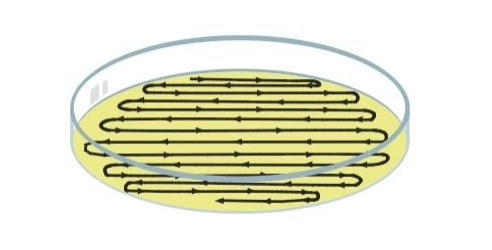
Thorough and precautious swabs for each culture were taken, as the negative control was simply the lid of the plate being lifted (not removed or uncovered to prevent exposure) and a removal of a sterilized cotton swab and appliance to the agar culture by dragging the sterile end across the nutrient agar in a zigzag pattern, then rotating the dish 90 degrees and repeating the same swab. The zigzag pattern was as portrayed below:

Image showing the zigzag pattern that was performed for the swab

This process was repeated for the positive control swab except that this swab was a wet swab (water taken from the condensation on the lid of the plate) applied to the touch pad of my laptop and then transferred, by swabbing again on the agar plate to ensure that microbes present were collected. The same swab technique was also used for the experimental plate, except that before swabbing, the dry touch pad surface was sprayed using Lysol disinfectant spray and dried with a paper towel. After changing into a new pair of gloves, I proceeded to collect any microbes from my recently disinfected touch pad, and using the swab technique, I transferred the microbes to the experimental petri dish. All three plates were sealed using Parafilm to reduce airflow in order to prevent the microbes from performing aerobic respiration.

The next step was to incubate the cultures. An ideal space for incubation in a lab, would be inside of an incubator set for 37 degrees Celsius (98.6 degrees Fahrenheit), in a dark area. The incubation environment that I chose was on the counter next to the back of my fridge, under a black towel. The reason I chose this incubation environment was because it was the most consistent place (temperature wise) that provided heat and warmth, and the towel prevented direct light from hitting it which otherwise, would inhibit the growth of some microbes.

Referring to my lab notebook, the temperature in my house was typically 68-70 degrees Fahrenheit, recorded from my thermostat as I checked around 8pm every night over the course of 6 days, with a total incubation time of about 120 hours. From what was documented, and from analyzing the growth of the negative, positive, as well as experimental culture plates, microbe growth was not present. The appearance of any growth could not be seen. The results did not match my expected outcome as I predicted that the negative plate would have the least amount of microbes present, the positive would have the most, and the experimental would have a fewer amount. I would report my experiment and lab as failed, due to the lack of microbe growth, making results difficult to analyze and rely on since more microbes were supposed to appear in the positive control and did not. I believe that the reason my experiment failed, was because of the temperature of my incubation environment. Although the plates were placed near the back of the fridge for warmth, the temperature of my home in general remained to be a lower temperature, possibly preventing more accurate results. The final image of my experiment is below:

Image of culture plate on December 13th
Design a site like this with WordPress.com
Get started